
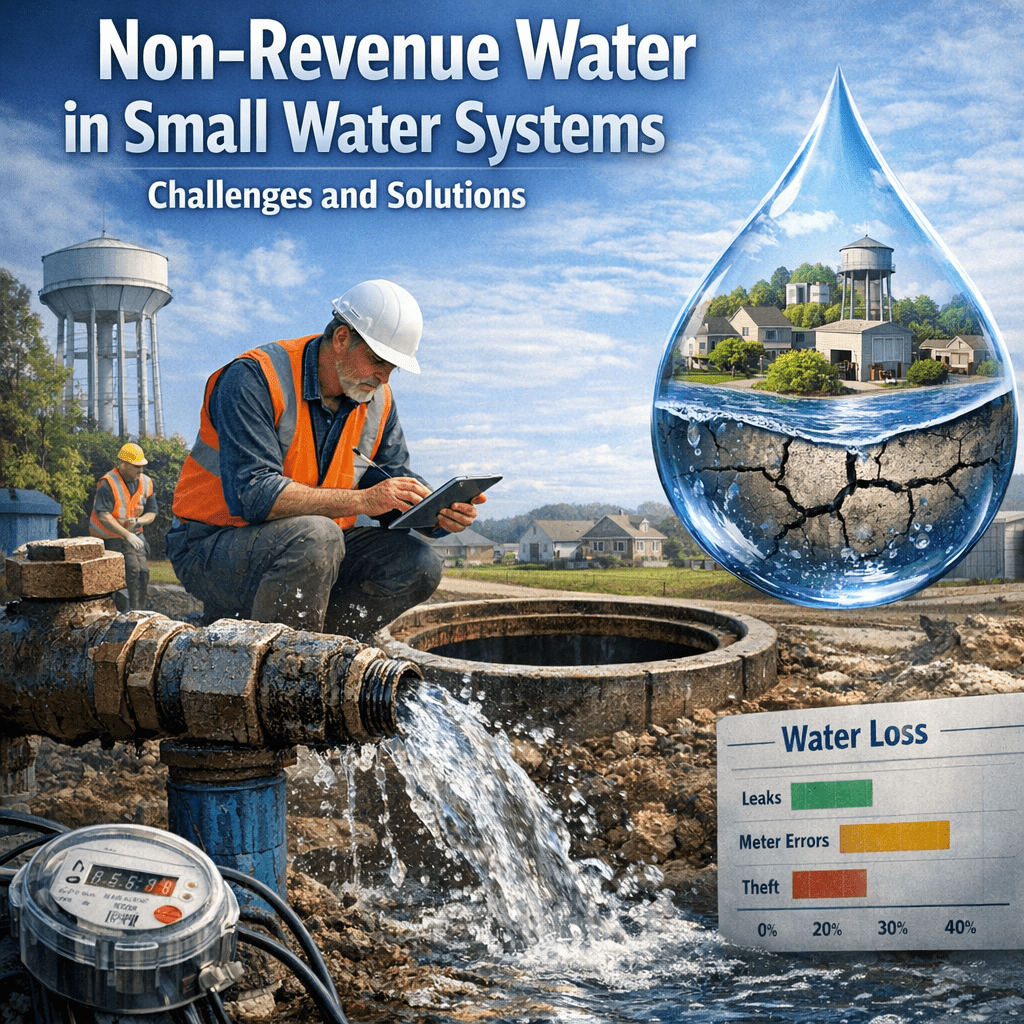
- Non-Revenue Water (NRW) is defined by the IWA methodology as consisting of Apparent Losses (metering inaccuracies, theft) and Real Losses (physical leakage). A validated water audit is the mandatory first step to accurately quantify these components.
- NRW is a critical economic issue, costing global utilities an estimated $14 billion annually. Reduction programs yield rapid Return on Investment (ROI) by lowering pumping costs and deferring costly new supply infrastructure.
- Reducing Real Losses requires proactive strategies, primarily focusing on pressure management (the most cost-effective solution), establishing District Metered Areas (DMAs), and deploying advanced leak detection technology.
- For accurate benchmarking, utilities must shift from misleading NRW percentages to absolute indicators, such as losses per connection per day and the Infrastructure Leakage Index (ILI), which measures true system efficiency.
Table of Contents
- Defining Non-Revenue Water (NRW) for Small Water Utilities
- Quantifying Non-Revenue Water (NRW) via IWA Methodology
- Apparent Losses: Addressing Commercial Discrepancies
- Real Losses: Infrastructure Leakage and Detection
- The Mandate: Implementing the Water Audit
- Strategies for Reducing Real Losses in the Water Distribution Network
- Economic Imperatives and Global Non-Revenue Water Benchmarks
- Why Small Water Utilities Must Address Non-Revenue Water Immediately
- Technical Overview of Non-Revenue Water Components and Benchmarking
Defining Non-Revenue Water (NRW) for Small Water Utilities
Non-revenue water (NRW) represents the volume discrepancy between the water supplied to the water distribution network and the volume of water billed to consumers. Controlling NRW is paramount for the financial and technical stability of small water utilities.
Quantifying Non-Revenue Water (NRW) via IWA Methodology
Non-revenue water (NRW) is defined precisely as the volume of water produced and introduced into the water distribution network that is ultimately not billed to customers. This volume encompasses both physical losses (leakage) and administrative discrepancies (commercial losses). For small water utilities, effective NRW reduction strategies offer superior cost-effectiveness and rapid return on investment compared to costly supply augmentation projects.
Failure to accurately measure NRW results in massive economic burdens worldwide. The World Bank estimates global utility water losses exceed US$14 billion annually. Reducing high levels of NRW can generate US$2.9 billion in revenue and extend water service to an additional 90 million people, emphasizing the immediate financial impact for small systems.
Apparent Losses: Addressing Commercial Discrepancies
Accurate water metering is foundational for estimating consumption and calculating the true volume of NRW. Faulty or aging meters are a primary driver of apparent losses, as they typically under-register consumption, directly compromising billing accuracy and impacting overall financial stability. By establishing accurate water balances and district metered areas, utilities can further enhance their metering strategies.
Real Losses: Infrastructure Leakage and Detection
Real losses, also termed physical losses, constitute the volume of water escaping the distribution network through structural failures. These failures primarily stem from aging pipelines, substandard installation practices, and insufficient pressure management. High physical losses directly increase operational costs related to energy consumption for pumping and chemical treatment.
The challenge of controlling water losses is globally significant. While highly developed systems, such as those maintained in Singapore, report Non-Revenue Water (NRW) levels near 5 percent, many international regions struggle significantly. For example, the World Bank documented instances where NRW exceeded 40 percent. Historical data from countries like Nigeria, pre-2003, indicated losses nearing 96 percent of total water supply. Effective management of real losses is mandatory for system viability.
The economic consequences of uncontrolled real losses are substantial. The World Bank estimates that global water utilities lose approximately US$14 billion annually due to system inefficiencies and leakage. Reducing NRW directly translates into potential revenue generation and improved resource availability for expanding service, making NRW reduction a high-return investment for small water utilities.
Benchmarking Efficiency using International Water Association (IWA) Standards
Expressing Non-Revenue Water solely as a percentage of total water supplied is often misleading, particularly in systems with highly variable consumption. This relative percentage is influenced by total sales volume, thus masking true physical system inefficiency.
The International Water Association (IWA) methodology mandates the use of absolute indicators to provide robust and comparable benchmarks for system efficiency across different water utilities. Applying these metrics standardizes performance assessment.
Implement the following IWA absolute indicators for accurate benchmarking:
- Losses per Connection per Day: Quantify leakage in liters per connection per day (L/conn/day). This metric normalizes losses based on the service density of the distribution network.
- Losses per Kilometer of Main per Day: Measure leakage volume in cubic meters per kilometer of distribution network per day (m³/km/day). This metric normalizes losses based on the total infrastructure length.
The Infrastructure Leakage Index (ILI) is the globally recognized metric for advanced performance assessment. The ILI compares the Current Annual Real Losses (CARL) to the Unavoidable Minimum Annual Real Losses (UMARL). This calculation provides a comprehensive, standardized measure of operational performance achievable by the water distribution network.
The Mandate: Implementing the Water Audit
Controlling Non-Revenue Water (NRW) begins with accurate measurement. A comprehensive water audit is the foundational step required for any effective NRW reduction program.
The audit systematically quantifies the volume of water produced, consumed, and lost. This data is mandatory for prioritizing investments and calculating the potential return on investment (ROI) from reducing water losses.
Defining Non-Revenue Water: The IWA Methodology
Small water utilities must adopt standardized practices to measure NRW. The International Water Association (IWA) methodology provides the global framework for defining the water balance components.
NRW is defined as the volume of system input water that is not billed. This volume consists of three primary components: Unbilled Authorized Consumption, Apparent Losses, and Real Losses.
Apparent losses include errors from water metering inaccuracies and unauthorized consumption (water theft or illegal connections). Real losses are the physical losses from the water distribution network, primarily leakage.
Validated vs. Unvalidated Water Audits
The accuracy of the audit dictates the success of the NRW reduction strategy. Many small water utilities attempt internal, unvalidated water audits.
These unvalidated audits often rely on estimates for key variables, particularly for Unaccounted-for Water (UFW) components. Competitor analysis confirms that unvalidated audits can contain errors of plus or minus 50 percent or more.
The American Water Works Association (AWWA) promotes standardized auditing practices aligned with the IWA methodology. Utilities must prioritize a validated water audit.
Validation involves the rigorous testing and calibration of bulk and consumer meters, coupled with detailed mapping of the water distribution network and identification of unauthorized consumption points.
Validated audits are crucial for obtaining reliable data necessary for demonstrating short-term ROI and securing funding, potentially from organizations like the World Bank, for system improvements.
The Critical Role of Water Metering
Accurate water metering is essential for estimating the actual volume of water losses. Metering must occur at production sources, major distribution zones, and the customer level to establish reliable system input volumes.
Metering inaccuracies constitute a significant portion of apparent losses. Implement regular meter calibration schedules to minimize errors in both billed and unbilled consumption calculations.
The audit data facilitates the calculation of standardized NRW indicators, such as absolute losses per connection per day. This allows benchmarking against high-efficiency systems found in places like Singapore, Denmark, and Germany.
While global utilities lose an estimated US$14 billion annually due to NRW, validated audits provide the pathway to system stability. Successful utilities, such as those in Amman, Jordan, and Bangkok, demonstrate that comprehensive audits are the mandatory first step for effective NRW reduction.
For context, historical data shows some areas, such as Nigeria pre-2003, faced NRW levels near 96%. Reducing NRW is a global imperative, achievable only through accurate, validated data collection.
Expert Insight
“Given the US$14 billion annual loss globally, validated water loss and commercial audits are the mandatory, non-negotiable first step. They provide the foundational data necessary to calculate standardized indicators, achieve cost-effective NRW reduction, and ensure long-term system stability,” Global Water Efficiency Expert
Strategies for Reducing Real Losses in the Water Distribution Network
To effectively reduce Non-revenue water (NRW), specifically the real losses component, small water utilities must transition from reactive leak repair to proactive asset management strategies.
These strategies directly target the physical losses escaping the water distribution network, providing demonstrable short-term return on investment (ROI).
1. Implementing Advanced Pressure Management Systems
Pressure management is consistently identified as the single most cost-effective solution for reducing leakage volumes and mitigating new pipe failures.
Leakage flow rates are directly proportional to the system pressure. By implementing Pressure Reducing Valves (PRVs) and dynamically modulating pressure based on time-of-day demand, utilities achieve significant reductions in physical losses, pipe burst frequency, and operational energy costs.
Successful NRW reduction programs globally, including those implemented in Denmark and the Netherlands, rely heavily on advanced pressure control within defined zones.
2. Establishing District Metered Areas (DMAs)
DMAs involve segmenting the larger water distribution network into smaller, manageable zones. Each zone requires isolation and the installation of a bulk flow meter at the inlet.
This segmentation allows the utility to precisely measure NRW within specific zones, isolating high-loss areas for targeted intervention consistent with the International Water Association (IWA) methodology.
Instructional Steps for DMA Implementation:
- Identify natural hydraulic boundaries within the existing water distribution network.
- Isolate the zone hydraulically using boundary valves to ensure all water entering the DMA passes through a single inlet meter.
- Install validated bulk flow meters at the inlet of each defined zone.
- Integrate flow and pressure data logging systems to capture continuous network data.
- Monitor Minimum Night Flow (MNF). An unusually high MNF is the primary indicator used to isolate significant, undetected leakage (real losses) within that specific DMA.
This process provides the localized data necessary to manage the Infrastructure Leakage Index (ILI) and prioritize resources for targeted leak detection.
3. Innovative Leak Detection Methods
While standard acoustic detection remains necessary, small water utilities with limited field crews benefit immensely from modern, non-invasive technology used to efficiently locate physical losses.
These innovative methods drastically reduce the time and expense associated with leak surveying large sections of the water distribution network.
| Method | Principle of Operation | Application for Small Water Utilities |
|---|---|---|
| Satellite Leak Detection | Utilizes Synthetic Aperture Radar (SAR) imagery to detect subsurface water leaks through specialized moisture content analysis of the surrounding ground. | Effective for rapid, non-invasive assessment of large areas and rural pipes; reduces initial survey time before ground crews are deployed. |
| Acoustic Sensors (Permanent) | Fixed sensors deployed throughout the network that continuously monitor for noise anomalies characteristic of leak sounds. Data is automatically transmitted for analysis. | Ideal for high-pressure transmission mains or critical supply lines; provides real-time alerts for immediate response to new physical losses. |
| Drone/UAV Thermal Imaging | Uses high-resolution infrared cameras to detect subtle temperature variations caused by the evaporation of leaked water near the surface. | Useful for detection in remote or difficult-to-access areas, including identifying leaks around storage tanks and reservoirs. |
| Correlators and Ground Microphones | Standardized acoustic tools utilized to calculate and pinpoint the precise location of the leak source by measuring sound travel time between two points. | Necessary for final, precise location verification before excavation and repair, following DMA isolation and initial detection. |
Implementing a combination of these technologies enables small water utilities to significantly reduce NRW by rapidly addressing real losses, thereby protecting the overall water supply.
Economic Imperatives and Global Non-Revenue Water Benchmarks
Addressing Non-Revenue Water (NRW) constitutes an economic imperative for all water utilities, particularly small systems where budget constraints amplify the impact of water losses.
The global scale of utility inefficiency due to NRW is estimated by the World Bank to exceed US$14 billion annually. Successful NRW reduction programs can generate US$2.9 billion globally and extend reliable water supply to an additional 90 million people without necessitating new source development.
Defining and Quantifying Water Losses
To implement effective NRW reduction strategies, water utilities must first accurately define and quantify their losses using standardized procedures.
The International Water Association (IWA) methodology dictates that NRW is composed of three primary categories: Unbilled Authorized Consumption, Apparent Losses, and Real Losses.
Apparent Losses are non-physical losses, including metering inaccuracies, unbilled consumption, water theft, and illegal connections. Real Losses (physical losses) represent the physical leakage escaping the water distribution network.
A validated water audit is essential for determining the precise breakdown of these components. Unvalidated water audits frequently contain significant errors, potentially resulting in assessment inaccuracies of plus or minus 50 percent or more, rendering subsequent investment decisions unreliable.
Achievable Reduction Benchmarks
Sustained, structured commitment to NRW reduction yields demonstrable short-term return on investment (ROI). Successful global case studies establish achievable benchmarks for even the most challenged water utilities.
The utility in Phnom Penh, Cambodia, provides a critical example of long-term success. Through rigorous water metering, institutional reforms, and active pressure management, the utility reduced its NRW from 72 percent to approximately 6 percent over two decades.
This demonstrates that low NRW levels are achievable regardless of initial infrastructure conditions. Developed nations, such as Singapore, maintain stringent control, achieving NRW levels near 5 percent, reflecting continuous efficiency efforts also seen in Germany, the Netherlands, and Japan.
However, high levels of Unaccounted-for Water (UFW) persist across diverse settings, including Dhaka, Bangladesh, and cities throughout Italy and Chile. This confirms that managing water losses is a universal infrastructure management problem demanding immediate attention from all water utilities.
Why Small Water Utilities Must Address Non-Revenue Water Immediately
Small water utilities frequently postpone comprehensive Non-Revenue Water (NRW) programs, citing insufficient capital or technical capacity. This approach disregards the rapid Return on Investment (ROI) obtainable from targeted NRW reduction solutions.
Addressing Non-revenue water is not optional. The economic imperative is quantifiable: the World Bank estimates global utility inefficiency due to water losses exceeds US$14 billion annually. Successful NRW reduction programs globally can generate US$2.9 billion in savings, demonstrating the immediate financial benefit of action.
The implementation of validated water audits and modern technology generates measurable short-term returns. Reducing NRW by even a minimal percentage yields immediate operational improvements:
- Reduced Pumping Costs: Decreased volume requirements minimize energy expenditure associated with sourcing, treatment, and distribution pumping.
- Deferred Capital Expenditure: Effective NRW reduction frees existing water supply capacity. This delays the necessity for costly investments in new treatment plants or source development.
- Increased System Reliability: Proactive leakage detection and pressure management mitigate the risk of catastrophic main breaks. This improves overall water distribution network stability and quality of service.
Investment in thorough water audit methodologies and specialized leak detection technology, including advanced correlators and Geographic Information Systems (GIS) mapping tools, typically achieves payback within two to five years. This ROI is calculated based exclusively on saved energy and increased billed volume from recovered apparent losses and real losses.
Small water utilities must prioritize measuring and reducing NRW. Specialized consultants in hydrogeology and GIS can provide the technical expertise necessary to implement these programs efficiently. Managing NRW is a prerequisite for financial stability and responsible water resource management in the contemporary utility environment.
Technical Overview of Non-Revenue Water Components and Benchmarking
To successfully implement an NRW reduction program, small water utilities must first establish a precise technical understanding of the components driving their water losses.
The following technical definitions and metrics are essential for conducting a validated water audit and measuring operational efficiency.
What Constitutes Non-Revenue Water (NRW)?
Non-revenue water (NRW) is defined as the volume of treated water supplied into the water distribution network that is produced but ultimately lost before generating revenue from the consumer.
The International Water Association (IWA) methodology requires separation of NRW into three primary components: Unbilled Authorized Consumption, Apparent Losses, and Real Losses.
Real losses, also known as physical losses, represent the actual flow of water out of the system. This category includes background leakage, service connection leaks, main pipe breaks, and reservoir or storage tank overflows. These losses directly deplete the limited water supply resource.
Apparent losses are commercial losses that do not involve physical water leakage. These are primarily caused by systematic errors in customer water metering, data handling mistakes in billing systems, and unauthorized consumption, which encompasses water theft and illegal connections.
Accurate quantification of both real losses and apparent losses is mandatory for developing an effective NRW reduction strategy.
Why is the International Water Association (IWA) Water Audit Essential?
The IWA methodology provides the standardized global framework essential for conducting a reliable water audit. This approach allows small water utilities to move beyond simple assumptions and establish a detailed breakdown of volumetric water losses.
Assessment of NRW relies fundamentally on water metering the total volume of water produced and entered into the distribution system. This baseline measurement is critical for estimating the true scale of losses.
A significant challenge, particularly in developing countries, is the reliance on unvalidated audits. Without validated data, errors in loss estimation can exceed plus or minus 50% or more, leading to massive financial inefficiency and misdirected capital investment.
A validated water audit involves systematic field testing of bulk and customer meters, detailed spatial mapping of the water distribution network, and physical verification to locate and document illegal connections.
Selecting Appropriate NRW Benchmarks
While the percentage of NRW relative to total produced water is the most commonly cited indicator, it is highly unstable and often misleading, especially when comparing systems with differing consumption patterns.
The preferred technical standards, supported by organizations such as the American Water Works Association, rely on absolute NRW indicators to measure efficiency.
These absolute metrics include liters lost per service connection per day or cubic meters lost per kilometer of pipe per day. Using these stabilized benchmarks allows water utilities to compare operational efficiency effectively, whether operating in Amman, Jordan, Mexico City or anywhere else in the world.
The most rigorous technical benchmark for assessing physical loss management performance is the Infrastructure Leakage Index (ILI). The ILI compares the utility’s current level of leakage to the theoretical minimum achievable (Unavoidable Background Leakage), providing a clear performance score.
The Global Economic Imperative for NRW Reduction
Addressing Non-revenue water is an immediate global financial necessity, impacting the sustainability of every water supply system. The World Bank estimates that global utility losses due to inefficiency and water losses exceed US$14 billion annually.
Reducing NRW provides direct, short-term economic returns. The World Bank further projects that targeted improvements could generate US$2.9 billion in additional revenue and provide reliable service to an estimated 90 million more people worldwide.
The operational performance gap between utilities is vast. Highly efficient systems, such as Singapore, maintain NRW levels near 5%. Conversely, systems facing extreme infrastructural deficiencies, such as Nigeria prior to 2003, reported Unaccounted-for water (UFW) rates as high as 96%.
Focused management demonstrates that significant progress is achievable. For example, the utility serving Jakarta, Indonesia, reduced its NRW from 59% in 1998 to 42% by 2016 through focused management of both real losses and apparent losses.
Immediate and Long-Term Strategies for NRW Reduction
For small water utilities requiring rapid results in NRW reduction, implementing systematic pressure management is often the most immediate and cost-effective strategy to combat physical losses.
Pressure reducing valves (PRVs) must be installed to lower system pressure, particularly during low-demand periods (off-peak hours). This action directly reduces the flow rate of existing leakage and minimizes the likelihood of new pipe bursts in the water distribution network.
Sustained success requires long-term institutional commitment and investment. The utility in Phnom Penh, Cambodia, serves as a benchmark, having reduced its NRW from 72% to approximately 6% over two decades through comprehensive planning, institutional reform, and active leak detection.
Effective NRW management involves a constant cycle of validation and action: conducting validated water audits, implementing pressure management, deploying active leak control measures, and ensuring rigorous control of metering inaccuracies and water theft.