Sustainable Management for Small Water Systems

Table of Contents
- Our Approach: Solutions, Service, and Integrity
- Key Takeaways for Utility Managers
- The Unique Management Challenges of Small Utilities
- The Foundation: Asset Management Planning
- Essential Management Tools: Leveraging CUPSS
- Integrating Operations and Maintenance (O&M)
- Ensuring Long-Term Financial Sustainability
- Knowledge Retention and Succession Planning
- Accessing External Asset Management Resources
- Frequently Asked Questions
Small drinking water utilities and wastewater utilities are critical infrastructure in communities across the United States. Yet, they are often tasked with managing complex, aging infrastructure while operating under severe budget and staffing constraints.
This reality demands a focused, efficient approach to utility management. At Southeast Hydrogeology, PLLC, we bypass the bureaucratic overhead typical of large consulting organizations, providing the senior-level expertise you need to implement practical management systems.
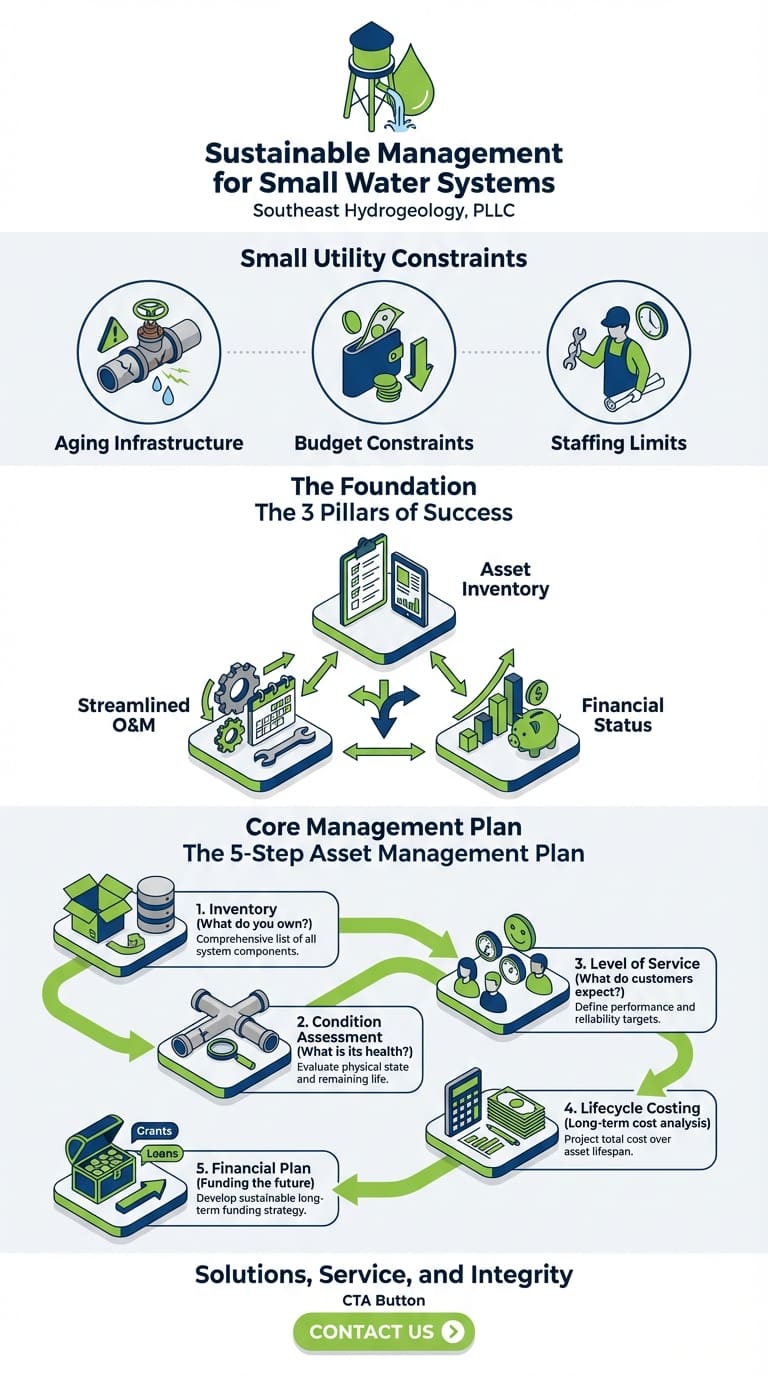
For resource-constrained small systems, effective management hinges on three critical pillars, forming the foundation of any successful asset management plan:
-
- Robust Asset Inventory documentation and knowledge.
-
- Streamlined Operations and Maintenance (O&M) protocols.
-
- Clear, actionable Financial status reporting.
To achieve long-term sustainability, leveraging the right structured processes and a dedicated asset management tool is non-negotiable. These tools are essential for utility managers seeking to maximize the life cycle of their assets and ensure compliance.
Our Approach: Solutions, Service, and Integrity
Our firm understands the specific needs of small water systems. We focus on practical, senior-led solutions designed to manage limited resources efficiently:
-
- Small systems require tailored, efficient management approaches, not generic solutions.
-
- Success is built upon strong asset knowledge and clear, reliable financial status data.
-
- Implementing the correct asset management tool is crucial for long-term sustainability and operational excellence.
Key Takeaways for Utility Managers
As experienced management consultants specializing in optimizing resource-constrained utilities, we emphasize five critical areas that must be addressed immediately to ensure the longevity and financial viability of your operation.
-
-
The core foundation of sustainability for your small water systems, whether drinking water utilities or wastewater utilities, is a comprehensive Asset Management Plan, regardless of system size.
-
-
-
While the EPA’s Check-Up Program for Small Systems (CUPSS) served as a valuable historical resource and legacy software application, modern asset management demands integration with GIS technology. Moving beyond CUPSS ensures your Asset inventory is a dynamic, spatial Asset management tool.
-
-
-
Efficient tracking of Operations and maintenance (O&M) activities must transition from paper records to digital, spatial systems for accurate cost allocation and Process Management Plans for Small Water Utilities and predictive maintenance planning.
-
-
-
Financial management requires absolute transparency. Utilizing reliable financial reports to clearly demonstrate your current financial status is essential for justifying necessary rate adjustments to governing boards and the public.
-
-
-
Implementing a formal knowledge retention strategy is vital to counter high employee turnover and prevent the loss of institutional knowledge within small water systems.
-
The Unique Management Challenges of Small Utilities
Small water utilities (typically defined as those serving fewer than 10,000 people) face unique and disproportionate burdens. You are required to comply with the same rigorous EPA standards as massive metropolitan systems, but with a fraction of the budget and staff.
Based on our deep experience consulting with resource-constrained operations, the primary obstacles are clear. These involve managing aging infrastructure, a critical lack of technical resources, and the constant difficulty in demonstrating the long-term financial status necessary to secure vital capital investment.
This operational reality means that efficiency is not a luxury; it is the core requirement for survival. Your ability to maintain compliance and secure funding hinges entirely on having a documented Asset management plan.
“For small water systems, every dollar spent on reactive repairs is a dollar that could have been invested proactively. Our goal is to shift that mindset through structured, low-cost management solutions tailored specifically for drinking water utilities and wastewater utilities.”
To overcome these systemic challenges, small systems must adopt structured processes. This starts with creating a comprehensive asset inventory and establishing clear operations and maintenance protocols. We guide clients toward leveraging established federal Asset management resources that streamline this effort, such as those promoted by the EPA.
The Foundation: Asset Management Planning
For small, resource-constrained utilities, moving past reactive crisis management is essential for long-term viability. The single most effective tool for achieving this shift is a formal asset management plan.
The core objective is simple, yet powerful: to provide a specified level of service at the lowest possible lifecycle cost. This requires proactive stewardship, not just daily fixes.
Why Asset Management is Critical Now
The EPA strongly encourages all drinking water utilities and wastewater utilities to establish formal asset management practices. This guidance comes directly from the EPA’s Office of Groundwater and Drinking Water (OGWDW).
This planning is not optional if you seek external support. Demonstrated financial and managerial capacity, often proven through an asset management plan, is critical for securing state and federal funding.
Our experience shows that successful small systems use this framework to optimize their operations and maintenance schedules and improve their overall financial status.
The Five Pillars of a Strong Asset Management Plan
A comprehensive plan tailored for small water systems must address five critical areas. If you neglect any one of these, your utility remains vulnerable to unexpected failures:
-
- Asset Inventory: Knowing precisely what you own, where it is located, and its age.
- Condition Assessment: Evaluating the current health and remaining useful life of each asset.
- Level of Service: Defining the service standards your community expects and can afford.
- Lifecycle Costing: Determining the lowest long-term cost of owning, operating, and replacing assets.
- Financial Plan: Ensuring sufficient capital is available for planned renewal and replacement based on accurate financial reports.
Leveraging the CUPSS Asset Management Tool
We understand that developing a complex asset management system may seem daunting, especially with limited staff. Fortunately, the EPA has developed specific asset management resources designed explicitly for small systems.
The primary resource is the Check-Up Program for Small Systems (CUPSS). This free, user-friendly asset management tool provides the structure needed to create a robust plan without requiring specialized software or extensive technical training.
The CUPSS background is rooted in practicality. It guides small water systems through the entire process, helping you create a detailed asset inventory, define maintenance tasks, and project long-term capital needs.
While the original legacy software application is aging, the methodology remains the gold standard for resource planning. You can also utilize the Full CUPSS User’s Guide (PDF) and simple templates built on Microsoft Excel to manage your data.
For utilities seeking deeper guidance, the EPA’s Simple Tools for Effective Performance (STEP) Guide series and the companion document, Asset Management Resources for States and Small Drinking Water Systems, offer invaluable support for a range of challenges, althought is not software-based.
Essential Management Tools: Leveraging CUPSS
In your pursuit of formalized asset management, you likely encountered the primary entry point for many resource-constrained utilities: the Check-Up Program for Small Systems, widely known as CUPSS.
For years, CUPSS served as the foundational asset management tool that allowed small water systems to transition from informal record-keeping to structured planning.
The Origins of the Check-Up Program for Small Systems (CUPSS)
CUPSS was developed specifically for drinking water utilities and wastewater utilities facing severe constraints. It was an initiative spearheaded by the EPA’s Office of Groundwater and Drinking Water (OGWDW).
The program was built upon the successful framework established by the EPA’s Simple Tools for Effective Performance (STEP) Guide series, designed to simplify complex utility management processes.
The objective of the CUPSS background was to provide a straightforward, accessible methodology for developing the initial asset management plan without requiring specialized software or extensive consulting fees.
Core Functionality: Building the Initial Asset Management Plan
The strength of CUPSS lies in its structured approach. It guides operators through the critical steps necessary to formalize their management processes. The tool helps you organize four essential areas:
-
- Creating a detailed record of your asset inventory, which lists all critical components.
-
- Scheduling required operations and maintenance (O&M) tasks to optimize efficiency.
-
- Gaining an understanding of your financial status and projecting capital needs.
-
- Generating a tailored, executable asset management plan based on calculated risks and costs.
Recognizing CUPSS as a Legacy Software Application
While the sotware’s principles remain useful, it is important to recognize CUPSS’s status as a legacy software application. We need to be transparent about its limitations moving forward.
As of 2026, the original CUPSS software is no longer updated or actively supported by the EPA. It often struggles with compatibility on modern computer operating systems and lacks the dynamic features necessary for today’s operational demands.
For utilities relying on older versions, it is critical to transition your data to a more robust, supported platform to ensure continuity and prevent data loss.
Transitioning Beyond Static Planning
If your utility is still relying on static planning tools, such as the Full CUPSS User’s Guide (PDF), basic Microsoft Excel spreadsheets, or outdated paper records, you are limiting your ability to achieve true predictive maintenance.
These static methods complicate essential functions like generating timely financial reports, tracking work orders, and accessing crucial asset management resources available through programs like the Water Finance Clearinghouse or the Drinking Water Training System.
Our experience shows that utilities achieve great benefits by moving their data from these isolated documents into integrated, accessible systems. This also ensures compliance and helps in capturing institutional knowledge, often facilitated by tools like a detailed Knowledge Retention Tool Spreadsheet for Small Water Systems.
Why Modern Systems Demand GIS Integration
The modern standard for effective asset management is Geographic Information Systems (GIS) integration. This is where Southeast Hydrogeology, PLLC delivers specialized value, transitioning utilities from the static planning of the past to the dynamic mapping of the future.
A modern system uses GIS to link your physical assets (pipes, valves, hydrants, and pumps) directly to their maintenance history, condition assessment data, and remaining useful life.
This spatial approach allows managers to visualize risk, prioritize capital improvement projects based on real-world data, and achieve truly proactive, rather than reactive, management. Additionally, incorporating Systematic Well Management practices can further enhance your utility’s operational efficiency.
Integrating Operations and Maintenance (O&M)
Effective operations and maintenance (O&M) is where your formalized asset management plan meets daily reality. Following the foundational work you may have completed using tools like the Check-Up Program for Small Systems (CUPSS), the critical next step is standardizing how your field crews execute maintenance across your small water systems.
The greatest structural weakness in many resource-constrained utilities is relying on institutional knowledge held by one or two long-term operators. If they leave, that detailed operational history and compliance knowledge walks directly out the door.
To ensure continuity and integrity, O&M procedures must be standardized, easily documented, and immediately accessible. Our firm helps utilities leverage integrated digital systems, specifically those combining Computerized Maintenance Management Systems (CMMS) with Geographic Information Systems (GIS), including Standard Operating Procedures (SOP), to capture this critical data.
Standardizing Field Operations and Knowledge Retention
Digital O&M systems allow field crews to log work orders, inspections, and repairs in real time, directly tied to the asset’s spatial location on a map. This fundamentally transforms how you manage your asset inventory and reduces reliance on memory or physical files.
This integration dramatically improves compliance reporting accuracy and builds the necessary historical data to inform long-term planning. This robust data set is essential for generating accurate financial reports and making sound capital improvement decisions based on true asset performance.
Digital Transformation: Integrated GIS/CMMS Platforms
We provide consulting to small systems transitioning from traditional methods to integrated digital platforms. For the proactive manager of a drinking water utility or wastewater utility, the difference in efficiency, data quality, and knowledge retention is striking and immediately beneficial to long-term operational success.
| Feature | Traditional Paper/Spreadsheet | Integrated GIS/CMMS Platform |
|---|---|---|
| Asset Inventory | Static, updated annually, prone to errors. Lacks spatial accuracy. | Dynamic, real-time, spatially accurate (GIS-based). |
| Work Orders | Manual logging, difficult to track completion status, requires office input. | Automated scheduling, mobile access for field crews, time-stamped completion linked to location. |
| Data Accessibility | Limited to office computers or physical files. Institutional knowledge risk is high. | Field access via mobile devices, immediate reporting, centralized knowledge retention. |
| Regulatory Reporting | Time-consuming manual compilation of data, increasing labor costs. | Automated generation of compliance and performance reports, improving efficiency. |
Ensuring Long-Term Financial Sustainability
While effective Operations and Maintenance (O&M) manages daily expenses, the ultimate measure of success for small water systems is achieving financial self-sufficiency.
This means your rate structure must cover immediate operating costs, future capital replacement needs, and the necessary reserves to address unforeseen emergencies.
Your comprehensive asset management plan, often initiated using foundational tools like the CUPSS (Check-Up Program for Small Systems) asset management tool, is the technical justification for your financial needs.
It explicitly quantifies the risk and cost of deferred maintenance, providing defensible data for necessary rate adjustments for small systems.
Translating Technical Needs into Defensible Financial Reports
As a utility manager, you must be prepared to present clear, defensible financial reports to your governing boards or local councils.
These reports must transparently link required rate increases directly to the infrastructure needs documented within your asset management plan and asset inventory.
We emphasize full-cost accounting principles to ensure that all costs (operational, debt service, and capital replacement) are accurately reflected in your rates.
For small water systems seeking external support, the EPA’s Water Finance Clearinghouse provides excellent starting points for understanding funding options, best practices, and asset management resources.
At Southeast Hydrogeology, PLLC, we work directly with drinking water utilities and wastewater utilities to analyze their current financial status and develop customized rate models that support genuinely sustainable operations. We provide the senior-level expertise often unavailable in resource-constrained small systems, including systematic well management.
Knowledge Retention and Succession Planning
High turnover is not just an HR challenge; it is a critical threat to the long-term operational continuity of small systems. When an experienced operator at a drinking water utilities or wastewater utilities retires, decades of undocumented knowledge about infrastructure and operations and maintenance procedures can vanish instantly.
Your management systems must be explicitly designed to capture this institutional knowledge digitally. This is the cornerstone of reliable succession planning for small water systems.
The EPA provides useful resources, such as the Knowledge Retention Tool Spreadsheet for Small Water Systems, but the most effective strategy is embedding required documentation directly into the daily workflow of your team through the use of Standard Operating Procedures (SOPs) and other tools.
If maintenance procedures, critical asset inventory locations, and historical data are stored within a central, digital system (which should be integrated with your core asset management plan), the learning curve for new employees is drastically reduced.
This transparency is key to service reliability and ensures that valuable historical data remains accessible, safeguarding your investment in infrastructure health.
Accessing External Asset Management Resources
You are not required to build effective management systems from scratch. The reality of operating resource-constrained small systems means leveraging external support is essential.
The EPA (Environmental Protection Agency), specifically through the EPA’s Office of Groundwater and Drinking Water (OGDW), provides robust, free resources tailored for small water systems and wastewater utilities.
We frequently guide our clients toward these external support systems to establish a strong foundational structure without incurring unnecessary consulting costs.
The Check-Up Program for Small Systems (CUPSS)
The most critical asset management tool provided by the EPA is the Check-Up Program for Small Systems (CUPSS). This program is designed to guide managers through the five core phases of creating a comprehensive asset management plan.
CUPSS helps your team move beyond tribal knowledge and systematically document your assets, which is essential for effective knowledge retention and succession planning.
While the CUPSS background is rooted in a slightly legacy software application, its principles remain the cornerstone of sound utility management for small systems.
CUPSS Output and Application
CUPSS is structured to assist you in creating the necessary documentation for long-term operational success:
-
- Asset Inventory: Developing a complete record of all infrastructure components.
- Operations and Maintenance (O&M): Standardizing procedures to ensure consistent performance.
- Financial Status: Generating preliminary financial reports and projecting capital improvement needs.
- The Asset Management Plan: Consolidating all data into a cohesive, actionable strategy.
We recommend utilizing the Full CUPSS User’s Guide (PDF) and leveraging the associated Microsoft Excel templates for ease of use, even if your team chooses not to fully adopt the original software application.
Broader EPA Guidance and Training
Beyond CUPSS, the EPA maintains a wealth of complementary materials crucial for sustaining management improvements.
Be sure to consult the Asset Management Resources for States and Small Drinking Water Systems page maintained by the EPA for the latest guidance and training opportunities.
We also direct clients to the Simple Tools for Effective Performance (STEP) Guide series, which offers practical, actionable advice on everything from system security to energy efficiency.
Furthermore, professional development through the Drinking Water Training System can help staff master the technical and managerial skills required to operate modern systems effectively.
For financial planning assistance, the Water Finance Clearinghouse is an invaluable resource for identifying funding opportunities specific to your utility’s capital needs.
Our commitment is to provide customized, senior-level guidance that translates these national asset management resources (including specific tools like the Knowledge Retention Tool Spreadsheet for Small Water Systems) into actionable, low-overhead solutions for your specific utility.
Frequently Asked Questions
What is the most common mistake small water systems make regarding asset management?
The single most costly error we observe in small water systems is the reliance on reactive maintenance. You wait for critical assets to fail before addressing them.
This approach guarantees expensive, emergency repairs that severely impact your long-term financial status. To shift this pattern and begin building a sustainable asset management plan, the critical first step is establishing a comprehensive asset inventory.
Is the Check-Up Program for Small Systems (CUPSS) still a relevant asset management tool in 2026?
Yes and no. The foundational concepts and the comprehensive framework provided by the Check-Up Program for Small Systems (CUPSS) remain highly relevant for drafting your initial asset management plan.
The process flow outlined in the CUPSS background materials is excellent for structuring data. However, the software itself is now a legacy software application.
We advise small drinking water utilities and wastewater utilities to leverage the CUPSS framework to organize their initial asset inventory data, often utilizing tools like Microsoft Excel, and then immediately migrate that data into a modern, GIS-enabled platform for efficient daily operations and maintenance tracking.
How can a resource-constrained small utility afford modern GIS software?
This is a common concern. The good news is that the cost structure for GIS and related asset management tools has drastically improved. Many are now cloud-based, offering subscription models tailored specifically for small budgets.
Crucially, the investment is rapidly justified. The efficiency gains and cost savings realized from moving away from emergency repairs and improving operational efficiency typically offset the software investment within the first two to three years.
As specialty consultants, we assist small systems in finding cost-effective, customized GIS solutions that align precisely with their existing asset inventory size and budget constraints.
What specific role does the EPA play in supporting small drinking water utilities?
The EPA remains the central authority. Specifically, the EPA’s Office of Groundwater and Drinking Water (OGWDW) provides essential oversight, guidance, and critical asset management resources for states and small drinking water utilities.
Their support is multifaceted. They facilitate technical assistance providers, offer extensive funding programs detailed in the Water Finance Clearinghouse, and provide invaluable tools like the Simple Tools for Effective Performance (STEP) Guide series.
These resources are designed to ensure managerial, technical, and financial sustainability for small systems across the nation.
References
Infographic Summary