Asset Management for Small Water Utilities: 2026 Guide
- Mandatory Compliance: Asset Management (AM) is essential for small public water systems to meet 2026 EPA regulatory requirements and qualify for critical federal funding (like the DWSRF).
- Five Core Components: Successful AM is built upon five integrated steps: completing an Asset Inventory, defining Levels of Service, calculating Life-Cycle Costs, performing risk assessment, and developing long-term Capital Replacement Plans (CRPs).
- Proactive Strategy: Utilities must shift from reactive maintenance to proactive operations by using risk assessment to prioritize critical assets for repair and replacement, minimizing the total cost of ownership over the asset life.
- Secure Funding: Financial stability hinges on integrating Life-Cycle Costing and the 20-year CRP into annual rate modeling to justify necessary long-term funding and ensure sustainable infrastructure investment.
Table of Contents
- Strategic Imperatives for Small Public Water Systems
- Defining Asset Management for Compliance
- The Urgency of Life-Cycle Costing in 2026
- Introduction to Sustainable Water Infrastructure Management
- Regulatory Landscape: 2026 EPA Compliance
- The Five Core Components of Sustainable Asset Management
- Developing the Asset Management Program Roadmap for Water Utilities
- Funding Strategies for Small Utilities
- Frequently Asked Questions Regarding Asset Management Implementation
- Conclusion
Strategic Imperatives for Small Public Water Systems
The operational landscape for small water utilities and wastewater utilities in the United States demands proactive strategies for managing aging water infrastructure.
Regulatory requirements, especially those promoted by the EPA (Environmental Protection Agency), mandate a shift toward sustainable infrastructure management. This guide provides utility managers serving populations under 10,000 with a precise, instructional roadmap for implementing a robust Management Systems for Small Water Utilities in the United States program.
Asset Management is the practice of managing infrastructure capital assets to minimize the total cost of ownership while delivering agreed-upon service levels.
Effective AM ensures the longevity of your public water systems and secures long-term funding necessary for infrastructure capital assets.
Defining Asset Management for Compliance
Asset Management is fundamentally about maximizing the asset life of critical assets, moving beyond reactive maintenance toward proactive operations and maintenance.
The AWWA (American Water Works Association) framework aligns closely with EPA guidance, emphasizing the assessment of asset condition and asset performance.
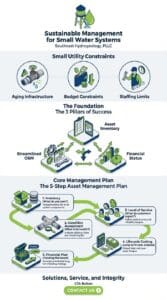
For small systems, AM implementation must focus on five core components, which collectively form the basis of a sustainable Asset Management Program.
These components allow utility managers to transition from crisis management to predictable financial planning and capital replacement plans.
The Urgency of Life-Cycle Costing in 2026
Financial stability hinges on accurately projecting life-cycle costs for all capital assets.
Waiting until assets fail results in exponentially higher repair and replace expenditures, undermining financial stability and service levels.
Successful Capital Assets Management requires understanding the total cost of ownership, from acquisition through operations and maintenance, rehabilitation, and final disposal.
This approach utilizes Life-Cycle Costing principles to optimize investment timing and minimize total cost over the entire asset life.
Implementing a formal Asset Management Program is the critical step toward securing long-term funding and achieving sustainable Water infrastructure.
Introduction to Sustainable Water Infrastructure Management
The effective management of infrastructure capital assets is mandatory for all public water systems. Federal regulatory requirements, particularly those promoted by the EPA, demand a systematic approach to infrastructure longevity.
For small water utilities (those serving under 10,000 customers in the United States), implementing a robust Asset Management Program (AM) is critical for maintaining compliance and ensuring long-term financial stability.
Asset Management provides utility managers and governing boards with a precise framework for managing capital assets. This framework facilitates informed decision-making based on data, not reactive crisis management.
The objective of AM is the achievement of Sustainable Water Infrastructure. This requires balancing three core elements: desired service levels, acceptable risk, and Life-Cycle Costing to minimize total cost across the entire Asset life.
This systematic approach, endorsed by organizations like the AWWA, integrates detailed Asset inventory data with proactive Operations and maintenance strategies.
Successful Capital Assets Management requires understanding the current Asset condition and predicting future needs. This integration maximizes the value derived from existing water infrastructure investment.
This guide provides the definitive roadmap for developing, implementing, and securing long-term funding for a sustainable AM program tailored specifically to the resource limitations of smaller operations.
Regulatory Landscape: 2026 EPA Compliance
The EPA (Environmental Protection Agency) establishes the foundation for modern Asset Management (AM) planning. These Regulatory requirements often dictate eligibility for critical federal funding.
The EPA prioritizes that Public water systems demonstrate a clear understanding of their system’s Capital assets and a robust Financial planning strategy for replacement.
Accessing the Drinking Water State Revolving Fund (DWSRF) now often necessitates an established Asset Management Program. This ensures public funds support Sustainable infrastructure investments.
Utility managers must demonstrate that investments are targeted toward high-risk mitigation, aligning with future Capital replacement plans. This approach maximizes the impact of limited Long-term funding resources.
The Mandate for Proactive Planning
Aging Water infrastructure across the United States drives the necessity for strategic planning. Reactive management leads inevitably to escalating Operations and maintenance costs and emergency repairs.
Implementing proactive AM, guided by Life-cycle costs, minimizes total cost of ownership. This requires identifying and prioritizing all Critical assets within the system.
A structured AM program addresses risk by shifting focus from reactive failure response to planned Repair and replace cycles. This strategy ensures long-term compliance and system resilience for your Water utilities.
Effective Capital Assets Management requires accurate data collection on asset condition and performance. This data forms the basis for all strategic decisions regarding Asset rehabilitation and replacement.
The Five Core Components of Sustainable Asset Management
Effective Asset Management Programs are mandatory for achieving Sustainable Water Infrastructure. These five core components structure the optimization of the Asset life cycle.
Implementing these steps sequentially builds a defensible and functional strategy for managing your Infrastructure capital assets, aligning your program with current EPA Regulatory requirements.
1. Asset Inventory and Criticality Assessment
The foundational step is developing a complete, accurate Asset Inventory. This process requires cataloging all physical Capital assets, including pipes, pumps, valves, and treatment components.
This inventory is the backbone of your Asset Management Program for both Water utilities and Wastewater utilities.
Data Collection and Assessment Steps:
- Record specific attributes: location (essential for GIS integration), installation date, material, size, and replacement cost.
- Implement rigorous Condition Assessment Programs. Evaluate the current physical state of Critical assets using field inspections or performance data.
- Determine Asset condition. Move beyond simple age-based assumptions to determine the actual remaining service life.
- Establish Criticality Ranking. Assess the consequence of failure on public health, environmental compliance, and defined Service levels.
Assets scoring highest in both poor Asset condition and high consequence of failure must be prioritized for immediate intervention and integration into the Capital Replacement Plans.
2. Defining Levels of Service (LOS)
Asset Management is fundamentally customer-driven. You must define measurable targets that specify the quality, reliability, and cost of service you intend to provide.
This commitment establishes the Levels of Service Framework.
The Utility managers, in conjunction with the Board, must establish two criteria: What level of service are we currently providing, and what level can we sustainably afford to provide?
These targets must link directly to the tracked Asset performance metrics. Example: Maintain a maximum of 1 unplanned water main break per 10 miles of pipe annually.
3. Life-Cycle Costing and Performance Evaluation
Understanding the Life-Cycle Costs of an asset is essential to minimize total cost of ownership. This component requires evaluating all expenditures from procurement through disposal.
Include initial capital, routine Operations and maintenance, energy consumption, Asset rehabilitation, and eventual replacement.
The AWWA (American Water Works Association) provides valuable resources such as the Effective Useful Life Tool. Use this tool for Effective Useful Life Estimation and renewal timing for various facility-based assets within the United States.
Calculating the full cost of ownership allows the utility to shift from reactive maintenance to Proactive Operations and Maintenance, thereby prolonging Asset life and maximizing return on investment.
4. Risk and Business Case Evaluation
Risk evaluation systematically combines the probability of asset failure (based on Asset condition) with the consequence of that failure (criticality).
This combined score allows Utility managers to prioritize spending where it yields the highest reduction in system risk.
For every proposed intervention (whether Repair and replace or rehabilitation), develop a formal business case. This case justifies the investment by demonstrating the benefit derived from risk reduction relative to the cost.
The focus must be on maximizing system reliability for the least expenditure, adhering to the principles of Capital Assets Management and fostering Cross-sector Asset Management Programs.
5. Long-Term Funding and Capital Replacement Plans
The final component translates the technical assessment into a viable financial strategy. The development of robust Capital Replacement Plans (CRP) is mandatory for sustainable operation of Public water systems.
The CRP is a multi-year forecast (typically 10 to 20 years) detailing when Capital assets will require significant investment or Asset rehabilitation.
This plan must be integrated into the utility’s comprehensive Financial planning process. Ensure adequate revenues are generated through rates or external sources to cover projected needs.
This is where formal Long-term funding strategies are formalized, moving the utility away from crisis-driven borrowing and towards secure Sustainable infrastructure management.
Developing the Asset Management Program Roadmap for Water Utilities
A successful Asset Management Program (AMP) for small water utilities requires a scalable, focused approach. Limited staff and financial resources necessitate prioritizing infrastructure capital assets based on risk.
This four-phase roadmap provides utility managers and boards with the instructions necessary to implement a functional AMP, ensuring compliance with evolving EPA regulatory requirements.
Phase 1: Mobilization and Critical Asset Inventory (6 Months)
The initial phase establishes the foundation of the Asset Management Program by focusing on essential data collection and team formation.
-
Form the Core AM Team: Appoint representatives from Operations and maintenance, Finance, and Governance. Ensure this team understands the Levels of Service Framework.
-
Identify Critical Assets: Pinpoint the top 20% of infrastructure capital assets whose failure would cause the greatest disruption. These critical assets typically include sole-source pumps, primary transmission mains, and key treatment components.
-
Audit Existing Data: Utilize all available records (GIS maps, SCADA logs, maintenance history, and financial records) to populate the initial Asset inventory for these critical items.
-
Establish Baseline Performance: Document the current operational performance metrics for each critical asset identified. This forms the basis for future Asset performance monitoring.
Phase 2: Defining Service Levels and Assessing Asset Condition (12 Months)
Phase 2 translates operational goals into measurable targets and establishes the physical state of the prioritized assets.
-
Define Levels of Service (LOS): Establish 3 to 5 measurable targets reflecting customer expectations (e.g., pressure, response time, water quality). Ensure LOS targets are realistic for your public water systems.
-
Conduct Condition Assessment Programs: Perform initial, high-level Asset condition assessments for the critical assets identified in Phase 1. Prioritize non-invasive methods where feasible.
-
Estimate Remaining Asset Life: Use tools such as the AWWA Effective Useful Life Estimation Tool to establish baseline replacement timing and project the Asset life remaining for each critical component.
Phase 3: Financial Planning and Capital Replacement Strategy (18 Months)
This phase integrates technical data with financial requirements to develop a proactive strategy for Asset rehabilitation and replacement, aiming to minimize total cost.
-
Calculate Life-Cycle Costs: Determine the total Life-Cycle Costing for each critical asset, including acquisition, operations, maintenance, and disposal costs. This calculation drives efficient long-term funding decisions.
-
Develop the Capital Replacement Plan (CRP): Draft the initial 5-year Capital Replacement Plans based on risk prioritization (Probability of Failure x Consequence of Failure). Focus the CRP on the repair and replace schedule for critical assets.
-
Identify Financial Gaps: Analyze the required Capital assets budget versus current reserves and revenue projections. Begin preliminary rate studies necessary for financial planning to close identified funding gaps and ensure sustainable infrastructure investment.
Phase 4: Integration, Expansion, and Sustainability (Ongoing)
The final phase formalizes the Asset Management Program into daily utility operations and prepares for continuous improvement and expansion across all infrastructure capital assets.
-
Integrate into Daily Workflow: Embed the AM plan principles into standard Proactive Operations and Maintenance procedures. Ensure staff utilizes the Asset inventory data daily.
-
Expand the Program: Systematically expand the Asset inventory and Asset condition assessment to encompass all remaining system components (e.g., secondary distribution lines, hydrants, valves).
-
Annual Review and Update: Review and update the Levels of Service, risk prioritization, and the Capital Replacement Plans annually. Utilize feedback loops to ensure the Asset Management Program continually improves Asset performance and addresses regulatory requirements.
Funding Strategies for Small Utilities
Securing Long-term funding is the most critical hurdle for small Water utilities. Effective Financial planning must integrate the comprehensive data generated by the Asset Management Program.
You must shift funding justification from reactive maintenance to proactive investment based on Life-Cycle Costing. This demonstrates commitment to Sustainable infrastructure and responsible Capital Assets Management.
Prerequisites for Capital Access
A formalized Asset Management plan is a mandatory prerequisite for accessing most state and federal funding sources. This documentation proves the utility is prioritizing investments based on risk and maintaining compliance with Regulatory requirements established by the EPA.
The Asset Management Program provides the necessary documentation, including detailed Capital Replacement Plans and projections for Operations and maintenance costs, required by lenders.
The following table compares common funding sources available for small system Asset Management Programs in the United States.
| Funding Source | Purpose/Eligibility | Key Benefit | Requirements (AM Plan Focus) |
|---|---|---|---|
| Drinking Water State Revolving Fund (DWSRF) | Infrastructure construction, rehabilitation, or replacement projects for Public water systems. | Provides low-interest loans; potential for principal forgiveness, reducing local burden. | Demonstrated financial capacity and technical viability. Requires an existing or developing, risk-based Asset Management Program. |
| USDA Rural Development (RD) | Water and Wastewater utilities infrastructure, prioritizing rural systems serving populations under 10,000. | Significant grant funding and loans available, minimizing reliance on local rates. | Must serve a defined rural area. Detailed Capital replacement plans and proof of local need are essential. |
| Local Rate Adjustments | Covers routine Operations and maintenance and long-term capital needs. | Sustainable, reliable, and entirely local funding source, independent of federal cycles. | Requires robust Financial planning and public justification using Asset condition data to validate rate necessity. |
| Water Infrastructure Finance and Innovation Act (WIFIA) | Large, complex Water infrastructure projects. | Favorable terms, flexible repayment schedules for up to 49 years. | Accessed by smaller utilities primarily through pooled financing mechanisms. Requires mature, risk-based Cross-sector Asset Management Programs and documentation of Life-cycle costs. |
Integrating Asset Management Data into Rate Modeling
Effective Financial planning demands that the Utility managers utilize AM data to justify rate adjustments. Demonstrating that investments are prioritized based on risk, rather than reaction, builds public trust and supports the necessity of Long-term funding.
Follow these steps to link your Asset Management data directly to your financial model:
- Establish Asset Condition and Performance: Complete the Asset inventory and conduct a formal Condition Assessment Programs for all Critical assets.
- Calculate Total Cost: Determine the full Life-cycle costs for each asset, including future Asset rehabilitation and eventual Repair and replace cycles.
- Develop the Capital Plan: Generate the 20-year Capital Replacement Plans using the projected failure dates and costs. These plans define future capital needs.
- Model Rate Requirements: Integrate the annual requirements from the Capital Replacement Plans into the rate model to maintain desired Service levels. The goal is to Minimize total cost over the asset life, not just the current year.
The AWWA standards strongly recommend linking funding models to the projected Asset life to ensure true long-term fiscal sustainability. This methodology ensures the utility manager can demonstrate accountability to the Board and the public.
Utilize the risk assessment output from your AM plan to define the necessary level of investment for maintaining Infrastructure capital assets.
Frequently Asked Questions Regarding Asset Management Implementation
What is the primary difference between reactive maintenance and proactive operations and maintenance?
Reactive maintenance addresses immediate failures, resulting in unpredictable downtime and high emergency costs. This approach undermines financial stability.
Proactive Operations and maintenance (O&M), central to any robust Asset Management Program, schedules interventions based on rigorous Asset condition monitoring and predicted failure curves. This data-driven strategy ensures consistent Service levels and works to Minimize total cost over the Asset life.
How does a small utility begin creating an Asset Inventory without expensive software?
Start with available resources. You do not require advanced proprietary software initially. Implement basic GIS tools to map distribution lines and facility locations. Southeast Hydrogeology recommends leveraging existing mapping data.
Focus the initial Asset Inventory on essential attributes: location, type, age, and maintenance history. Prioritize Critical assets first (those whose failure severely compromises Service levels or public safety). This baseline data establishes the foundation for managing all Infrastructure capital assets.
Is the Effective Useful Life Tool mandatory for small utilities?
No, the specific Effective Useful Life Tool itself is not mandatory. However, the requirement for sound Financial planning necessitates accurate Effective Useful Life Estimation for all Capital assets.
Organizations like the AWWA provide standardized methodologies to simplify this calculation. Utilizing these estimates provides a defensible baseline for Life-Cycle Costing and informs the Capital Replacement Plans required by modern EPA guidance, even before extensive Asset condition data is collected.
How often should the Capital Replacement Plan be updated?
Review and formally update the Capital Replacement Plan annually. This is a crucial step for maintaining sustainable Water infrastructure.
This mandatory annual update allows Utility managers to integrate new Asset condition data and adjust projections based on current Financial planning. Annual revision ensures compliance with evolving Regulatory requirements and supports the justification required for securing necessary Long-term funding.
What are the core components of a successful Asset Management program?
Effective Asset Management requires integration across five core components:
- Defining Service levels (what you deliver).
- Developing the Asset inventory and understanding Asset performance.
- Determining Life-cycle costs (managing risk vs. cost).
- Developing a prioritized Capital replacement plan.
- Establishing a sustainable Financial planning strategy.
These components are interdependent. Failure in one area, particularly Financial planning, compromises the entire program.
How does Asset Management help meet EPA Regulatory requirements?
The EPA strongly encourages or mandates robust Asset Management planning for many federal funding opportunities and compliance agreements.
Documenting your Asset inventory and utilizing a Capital Replacement Plan demonstrates proactive management of risk, capacity assurance, and financial sustainability. This is essential for all Public water systems in the United States.
What is the role of risk assessment in managing Capital Assets?
Risk assessment is the formal process of evaluating the likelihood of a failure against the consequence of that failure. This directly informs prioritization for Repair and replace decisions.
Focus resources on Infrastructure capital assets that present the highest risk score (high likelihood of failure AND high consequence of failure). This ensures limited Long-term funding is strategically applied to protect crucial Service levels.
Conclusion
The implementation of comprehensive Asset Management (AM) principles is now a fundamental requirement for water utilities across the United States. Compliance with current EPA regulatory requirements necessitates that all public water systems establish formal Asset Management Programs.
For small systems, success hinges on a phased, risk-based approach focusing on the five core AM components. This commitment ensures the long-term viability of your sustainable water infrastructure.
Effective AM reduces exposure to failure risk and minimizes overall Life-Cycle Costs. Utility managers must begin by establishing a complete Asset Inventory and defining appropriate Service Levels for customers.
Prioritize the assessment of Asset Condition and Asset Performance for Critical Assets. This data drives the shift from reactive response to scheduled Proactive Operations and Maintenance.
Sustainable AM requires robust Financial Planning. The technical data collected must directly inform your Capital Replacement Plans (CRP). These plans detail the necessary funding for Asset Rehabilitation and replacement over the Asset Life.
Utilize established industry tools, such as those promoted by the AWWA, to conduct accurate Life-Cycle Costing and defensible Effective Useful Life Estimation. The goal is to maximize the utility of existing Infrastructure Capital Assets while planning for future needs.
Southeast Hydrogeology specializes in providing the necessary GIS and spatial analysis required to establish accurate Asset Inventory. We support defensible prioritization within your Asset Management Program, enabling you to strategically repair and replace assets to minimize total cost.